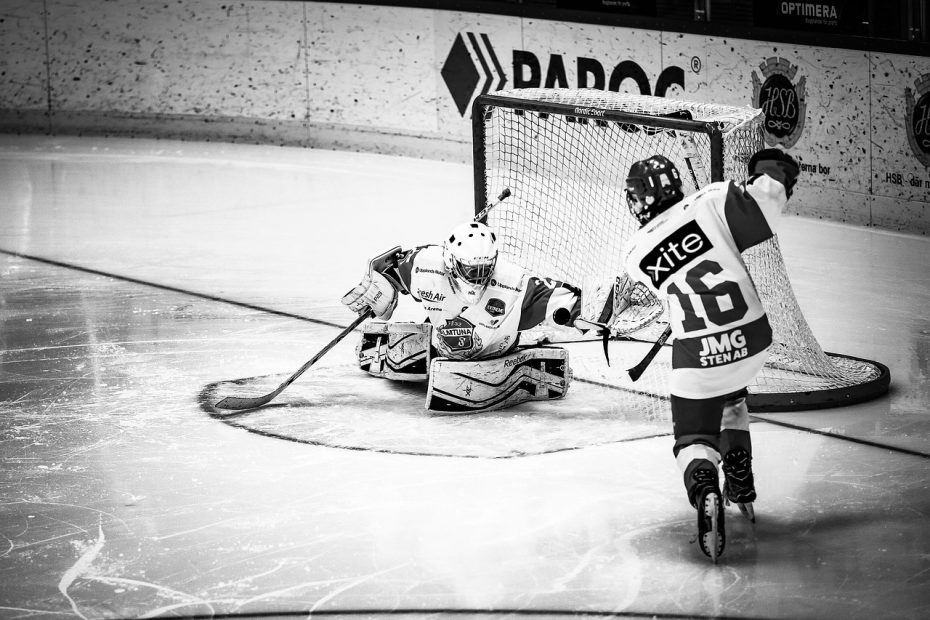
The Slap Shot Arms Race is the story of hockey learning that a shot could be more than a scoring attempt. In the hands of Bobby Hull, Al MacInnis, Zdeno Chara, Shea Weber, and other heavy shooters, the slap shot became a form of pressure. It changed how goaltenders prepared, how defenders blocked lanes, how power plays were designed, and how fans measured raw force. The shot was never only about speed. It was about fear, timing, release point, equipment, and the way one player’s windup could rearrange the entire defensive shape before the puck even left the stick.
How the Slap Shot Became Hockey’s Power Swing
The slap shot became famous because it looked different from every other hockey skill. A wrist shot could be quick. A backhand could be deceptive. A snap shot could punish a goalie before the defense settled. The slap shot, though, announced itself. The raised stick, the weight transfer, the blade hitting the ice before the puck, and the full-body release made it feel like hockey’s version of a power swing.
Bobby Hull gave that image its first great modern icon. Hull’s speed, strength, and shooting power made him one of the defining offensive players of the Original Six era, and his nickname, “The Golden Jet,” captured the way his skating and shot blended into one identity. Britannica describes Hull’s “swinging slap shot” as one of the traits that made him famous, while the NHL’s own remembrance of Hull emphasized how much his shot shaped the way opponents experienced him.
Hull’s slap shot mattered because it made power feel like a complete offensive system. It was not just a puck moving fast. It was a threat built from the rush, from open ice, from the curve of the stick, and from the fear that a goalie or defender might have only a fraction of a second to react. In that sense, Hull helped turn the slap shot into hockey’s loudest offensive language.
The slap shot also fit the game’s geometry. Hockey is played through lanes: passing lanes, shooting lanes, skating lanes, and sightlines through traffic. A massive slap shot attacked all of them. It forced defenders to step into danger, forced goaltenders to find the puck through bodies, and forced penalty killers to choose between pressuring the shooter or protecting the middle of the ice.
That is why the slap shot became especially important on the power play. A heavy shot from the point could score cleanly, create rebounds, produce deflections, or simply make defenders hesitate. Even when it missed, it could alter the next decision. The arms race was never just about who could shoot hardest. It was about who could make the other team feel the hardest shot was coming.
The Defensemen Who Made the Blue Line Feel Dangerous
The next phase of the Slap Shot Arms Race belonged largely to defensemen. Al MacInnis turned the point shot into one of hockey’s most feared weapons. The Hockey Hall of Fame notes that MacInnis won the NHL All-Star Game Hardest Shot competition seven times and became known for possessing the league’s hardest slap shot. It also notes that, as his game matured, MacInnis learned to use the fear of his shot to create other plays instead of firing it every time.
That detail is the heart of the story. The truly great slap shot did not only beat goalies. It manipulated defenders. When MacInnis wound up, penalty killers had to respect the blast. That opened seams. It created hesitation. It allowed a shooter to fake, step around a blocker, move the puck across the blue line, or wait for a screen to form. A hard shot became a tactical asset before it became an actual shot.
MacInnis also represented the wooden-stick era at its peak. His shot was not simply a product of modern composite technology. It came from repetition, strength, mechanics, balance, and accuracy. That made his power feel almost handmade. He was not just swinging hard. He was transferring force through the ice, the stick, and the puck with rare consistency.
Then the arms race changed again. Larger players, improved training, and composite sticks pushed the hardest-shot conversation into a new statistical era. Zdeno Chara became the most visible symbol of that shift. At 6-foot-9, Chara brought unusual leverage to the shot, and at the 2012 NHL All-Star Skills Competition he recorded a 108.8 mph shot, long treated as the NHL Hardest Shot benchmark. The NHL later noted that Martin Frk’s 109.2 mph shot surpassed Chara’s mark in a hardest-shot setting, but Chara’s 108.8 remains one of the sport’s defining power numbers.
Shea Weber then gave the modern slap shot another face. Weber’s shot was not only hard; it was heavy in the way players use that word inside the sport. It arrived with force, stayed dangerous through traffic, and made shot-blocking feel like a specialized kind of courage. In 2015, Weber won the NHL All-Star Hardest Shot competition with a 108.5 mph blast, just below Chara’s 108.8 mph mark.
By the Chara-Weber era, the slap shot had become both spectacle and strategy. The All-Star radar gun turned it into a measurable event, but NHL games gave it context. Coaches wanted the threat of the big shot, but they also needed quick decisions, lateral movement, deception, and traffic at the net. A 105 mph shot that never got through was less valuable than a slightly slower one that created chaos in front of the crease.
That tension changed the arms race. The question stopped being only, “Who shoots hardest?” It became, “Who can get the shot through?” In the modern NHL, defenders close faster, shooting lanes disappear quicker, and shot-blocking structures are more organized. The biggest weapon is no longer pure artillery. It is artillery with timing.
Why the Slap Shot Still Carries More Than Speed
The slap shot still matters because it represents one of hockey’s clearest power dynamics. It is shooter against goalie, but also shooter against every skater brave enough to step into the lane. It creates a moment of confrontation that fans understand instantly. The windup tells the arena what is coming. The sound tells everyone whether the shot was clean. The rebound, block, save, or goal tells the rest of the story.
That is why Hull, MacInnis, Chara, and Weber belong in the same larger conversation even though they played in different eras. Hull made the shot mythic. MacInnis made it a blue-line weapon. Chara made it a radar-gun landmark. Weber made it feel modern, repeatable, and punishing inside structured NHL systems.
The slap shot’s legacy is also visible in how the sport has adapted against it. Teams collapse into lanes. Forwards pressure points aggressively. Defensemen change angles rather than simply blasting away. Power plays use one-timers from the circles, bumper plays, royal-road passes, and quick releases because the game has learned how difficult it is to get a full windup through a modern defensive shell.
Still, the hardest shot keeps its grip on hockey imagination. It is one of the few skills that feels both technical and elemental. It depends on mechanics, equipment, and timing, but it also carries the simple appeal of force. A great slap shot can be measured in miles per hour, but its real value is measured in the reactions it creates before the puck arrives.
The Slap Shot Arms Race is not just a contest of speed. It is a history of hockey turning power into strategy. From Hull’s sweeping force to MacInnis at the point, from Chara’s record blast to Weber’s modern power-play threat, the slap shot became one of the sport’s most dramatic ways to change a game before the puck even reaches the net.