The Broad Street Bullies became one of hockey’s defining teams because the 1970s Philadelphia Flyers did more than win. They created a style that opponents had to answer physically, tactically, and mentally. Built around captain Bobby Clarke, goaltender Bernie Parent, coach Fred Shero, and a roster willing to turn every shift into a test of nerve, the Flyers won back-to-back Stanley Cups in 1974 and 1975. Their legacy is not only that they were tough. It is that they made toughness part of a complete team identity, combining intimidation with elite goaltending, scoring depth, structure, and citywide belief.
The Expansion Team That Had to Grow Up Fast
The Flyers entered the NHL as part of the 1967 expansion wave, which meant they had to build credibility in a league still shaped by the Original Six. For a new franchise, talent alone was not enough. Philadelphia needed a way to survive against older teams with deeper histories, stronger habits, and more established stars.
That pressure helped shape the Flyers’ personality. The team became difficult to play against by design. Under Fred Shero, Philadelphia developed a style that blended preparation, discipline, physical pressure, and emotional control. The Flyers were not simply a loose collection of aggressive players. They were a team with roles. Clarke drove the attack and set the competitive standard. Parent gave them championship-level goaltending. Bill Barber, Rick MacLeish, and Reggie Leach gave the team scoring ability. Dave Schultz, Bob Kelly, Andre Dupont, and others gave the Flyers a physical edge that forced opponents to account for every inch of ice.
That combination mattered. The “Broad Street Bullies” name survived because it described a real style, but it can also flatten what made the Flyers dangerous. Their penalty totals became famous, especially after Schultz set an NHL single-season record with 472 penalty minutes in 1974–75. But the team’s championship case was not built on penalties alone. In 1973–74, the Flyers finished with 112 points, second in the NHL behind Boston, and had four 30-goal scorers. Parent also set a league record with 47 wins and led the NHL with a 1.89 goals-against average and 12 shutouts.
The result was a team that could win in more than one way. Philadelphia could turn a game into a physical contest, but it could also defend, score, protect leads, and trust its goaltender. That is why the Flyers became more than a novelty. They became a model of how an expansion team could force its way into the center of the league.
The Stanley Cup Runs That Made the Bullies More Than a Nickname
The Broad Street Bullies became permanent hockey history in 1974. That spring, the Flyers defeated the Boston Bruins in six games to become the first NHL expansion-era team to win the Stanley Cup. The image of Clarke and Parent with the Cup at the Spectrum on May 19, 1974, mattered because it changed what expansion teams could imagine. Philadelphia had not merely joined the league. It had beaten one of its great powers and done it with a style no one could ignore.
The 1974 championship gave the Flyers legitimacy. The 1975 repeat gave them permanence. Philadelphia defeated the Buffalo Sabres in the Stanley Cup Final, with Parent again central to the title run. The Sabres’ own history of that series describes Parent as dominant in 1974–75, while the Flyers’ lineup around him included Clarke, MacLeish, Leach, Barber, Schultz, Dupont, and Kelly. That roster explains why the Bullies could be feared and respected at the same time: they had the muscle to unsettle teams, but also the stars to finish the job.
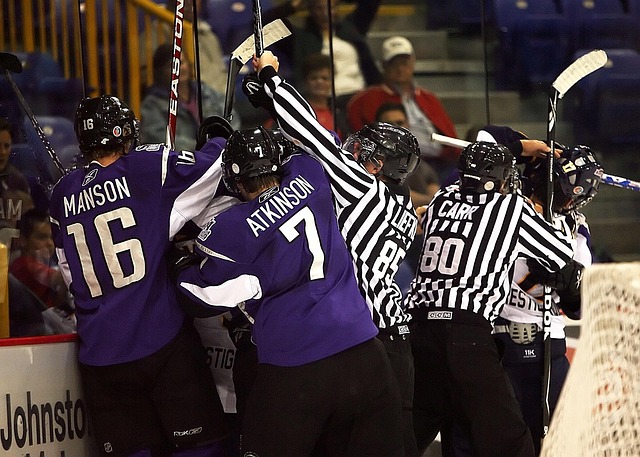
The Flyers’ intimidation was not separate from their hockey. It shaped the environment in which their skill players operated. Physical pressure created hesitation. Hesitation created space. Space allowed Philadelphia’s best players to make the plays that decided games. That was the Flyers’ deeper formula: force opponents into discomfort, then punish the mistakes that followed.
That is also why the team became so closely tied to Philadelphia’s sports identity. The Bullies looked like a city demanding recognition. They were direct, confrontational, organized, and difficult to move. Fans did not just see a winning team. They saw a team whose style felt emotionally legible: work hard, absorb pressure, give nothing away, and make every opponent remember the visit.
Why the Broad Street Bullies Still Shape Hockey Memory
The Broad Street Bullies still matter because they sit at the center of several hockey debates at once. They are part championship dynasty, part tactical case study, part city myth, and part argument about how physical hockey should be remembered. Their two Stanley Cups remain the Flyers’ only championships, which gives that era even greater weight inside the franchise’s identity.
Their legacy also complicates easy storytelling. The Flyers were not just a team that fought. They were a team that won. They had Hall of Fame-level figures, elite goaltending, high-end forwards, a distinct coaching voice, and a clear understanding of how to impose terms on a game. The franchise itself has noted that six major figures from the Bullies era are enshrined in the Hockey Hall of Fame: Parent, Clarke, Barber, Shero, Keith Allen, and Ed Snider.
At the same time, the Bullies helped push hockey into a long conversation about violence, spectacle, control, and responsibility. Their style drew admiration from Philadelphia and frustration elsewhere because it made games feel like contests of will as much as contests of skill. Later eras of hockey would move toward speed, spacing, and stricter enforcement, but the Bullies never disappeared from the sport’s memory. They became the reference point whenever people debated whether intimidation was a legitimate team identity or a force the league needed to restrain.
That tension is why the story endures. The Broad Street Bullies were not a footnote from a rougher era. They were champions who forced the NHL to confront what kind of sport it wanted to be. Their hockey was physical, skilled, structured, and impossible to separate from Philadelphia itself. Half a century later, the name still carries weight because it describes a team that turned pressure into a system and made intimidation part of winning.